If there is one good outcome from the wreckage of the Google’s effort to digitize the world’s books, it is the push that it gave to librarians like Robert Darnton to find a better way.  Google had wanted to build a search service for an enormous number of books, and it went to the trouble of digitizing more than 30 millions of them into a vast database. 

The only problem is that the whole enterprise was something of a betrayal of the public domain.  The world’s leading university research libraries were providing millions of books for free to Google, which was then planning to sell search subscriptions to these libraries to access the very same books via the Internet. Google also planned to sell the books at whatever prices it wished to set. One can easily imagine a new giant monopoly with a hammerlock on the digitized knowledge of the past century and beyond.

A number of parties, including Robert Darnton, the University Librarian at Harvard, opposed the Google Books project for locking up knowledge on terms set by Google, rather than allowing it to flow freely, without restriction, as is customary in scholarly commons.  The Google digital library project was essentially scuttled in March 2011 when a federal court struck down a settlement that had been negotiated among authors, publishers, Google and others.  The court held that it contained too many unlawful, unacceptable provisions. 

The good news is that some of the leading research universities in the US have risen to the challenge of creating a better, more accessible knowledge commons.  On April 18, the Digital Public Library of America will be launched as a way to make the holdings of US libraries, museums and archives freely accessible to anyone via the Internet.  The project represents a grand coalition of collaboration among leading university libraries, foundations and scholars.  DPLA describes itself as “an open, distributed network of comprehensive online resources that would draw on the nation’s living heritage from libraries, universities, archives and museums in order to educate, inform and empower everyone in the current and future generations.”  Darnton explains the planning, rationale and future of the DPLA in the latest issue of the New York Review of Books

When I was in Berlin, Matthias Spielkamp of iRights.info, interviewed me about the commons, especially the fate of various digital commons such as free software and the future of the Internet itself.  iRights.info is a German website that covers digital and intellectual property issues.  The video of that interview is now online – a short version (6:56) and a long version (24:37). 

Our conversation started with “What is the commons?” and moved on to such questions as “Free software often is a niche product.  Has it been a success?”.... “Can there be a regulation for the benefit of the commons?”.... and “Has governing the Internet become a public issue….or is it limited to specialized circles?” among other questions. 


The Man Who Quit Money

What does it mean to live without money?  Is it possible?  And how does it change one’s outlook on life and human relationships?  I stumbled across a wonderful book, The Man Who Quit Money (Riverhead Books, 2012), the story of Daniel Suelo, who, in the style of Henry David Thoreau, decided to live deliberately, and with clear purpose, by giving up money.  I’m a bit of a late-comer to Suelo’s story, which captured a lot of attention in late 2009 following a profile in Details magazine.

Suelo made the radical decision that he would not earn, receive or spend any money – his attempt to live life more directly and honestly.  In the book, journalist Mark Sundeen’s describes the journey that Suelo has taken over the past ten years in leading an active, productive, socially satisfying life without markets.  Just as anthropologists have often searched for the “savage child” raised by animals rather than humans (in order to assess the role of nurture vs. nature), Suelo, now 52, is that rare real-life example of what it means to live voluntarily outside of the market order without becoming a recluse.  Here is a real human being, not an abstraction, who does not want to be an employee, consumer or investor.

For shelter, Suelo has lived in a dozen of more caves in the canyons near Arches National Park, near Moab, Utah.  He forages for food from the desert – cactus pods, yucca seeds, wildflower and the like – and engages in dumpster-diving for food and clothing.  Born Daniel Shellabarger, he took the name “Suelo,” Spanish for “soil,” and decided to have the smallest possible ecological footprint as possible.

To outside appearances, Suelo could easily be seen as yet another homeless or mentally ill person without friends or family.  But despite maintaining a minimalist household comprised of discarded items, Suelo is no monastic or hermit.  He has many friends in town.  He sometimes house-sits and accepts meals from friends.  He volunteers for various community projects.  He wanders the Utah desert and meditates.  While his life is fairly impoverished by conventional standards, Suelo considers it a happy existence. 

Naturally, the reader wants to know how and why a person would choose to live this way.  Some explanations arise from the Christian fundamentalist upbringing that Suelo fled, before discovering that he was gay as well.  It would be easy to stereotype this story as one about a man on the run from himself.  But as the author Mark Sundeen makes clear, Suelo is brutally honest about himself and his search for authenticity – which is why this book raises some fascinating issues about what it means to live without money. 

Scholar of networked behavior David Ronfeldt has proposed an idea whose time may have arrived:  let’s create a new federated network of commons enterprises called the “Chamber of Commons.”  The term is a wonderful wordplay on the more familiar group, the U.S. Chamber of Commerce, the notoriously reactionary business lobby. 

A federation to help advance the commons paradigm and projects is a timely idea, especially in international circles and localities that enjoy a critical mass of commons projects.  We’ve already seen in digital spaces the value of mutual assistance rendered by various cyber-tribes to each other (free software hackers, free culture/Creative Commons advocates, open-access scholarly journals, Wikipedians, etc.).  There are inevitable tensions and disagreements, of course, but everyone has far more in common than the differences that separate them, and all sorts of innovations erupt. 

So why not a similar loose (or formal) federation of commons projects?  It would be especially exciting if a chamber of commons could begin to span the cultural barriers that divide digital and natural resource commoners, not to mention international political boundaries.  It would be great to create a common space for academic commoners and practitioner communities to build bridges, and also those involved in mainstream politics and those in “outside the system” advocacy.  Michel Bauwens of the P2P Foundation has proposed a similar set of federations of commons projects at the civic/institutional, economic and regional levels.

The Icelandic Putsch

It is the lazy conceit of the political class that “representative democracy” is the most reliable way of carrying out the public will.  Just as George W. Bush showed how the accountability mechanisms of state power are often more notional than real, the government of Iceland has now exposed its disdain for public opinion on matters of democratic empowerment.  A recent blog post by Thorvaldur Gylfason gets right to the point:  “Putsch:  Iceland’s crowd-sourced constitution killed by parliament.”  Gylfason is an economics professor blogging at the German blog Verfassungsblog (“on matters constitutional”).  

Iceland’s constitutional drama got its start following the 2008 crash.  As viewers of the film Inside Job will recall, the financial collapse was devastating to Iceland, which had set itself up as an offshore financial center.  After citizen protesters banged pots and pans in the street, demanding a new government, a new post-crash government eventually chose 950 random citizens to give their thoughts on a new constitution.  An elected constitutional council used social media to solicit the views of the public.

This open, thoughtful process was later invalidated by the country’s Supreme Court, which was dominated by justices belonging to the discredited political party responsible for the financial crash.  In response, the Icelandic parliament established a new constitutional council to draft a constitution.  That four-month process in 2011 yielded some remarkable reform proposals, as Gylfason writes: 

The constitutional bill stipulates, among other things: (a) electoral reform securing ‘one person, one vote’; (b) national ownership of natural resources; (c) direct democracy through national referenda; (d) freedom of information; and (e) environmental protection plus a number of new provisions designed to superimpose a layer of checks and balances on the existing system of semi-presidential parliamentary form of government. The preamble sets the tone: “We, the people of Iceland, wish to create a just society where everyone has a seat at the same table.” The people were invited to contribute to the drafting through the Constitutional Council’s interactive website. Foreign experts on constitutions, e.g. Prof. Jon Elster of Columbia University and Prof. Tom Ginsburg of the University of Chicago, have publicly praised the bill and the democratic way in which it was drafted.

By training Stefan Meretz is a German engineer and computer scientist, but he is also a deep theorist of the commons who has written often about commons-based peer production and the development of a free society beyond market and state.  Over the past several years I have learned a lot from Stefan's application of free software-inspired thinking to the commons.    

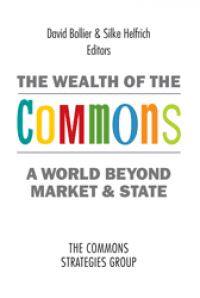
Below, I have posted his wonderful essay, “The Structural Communality of the Commons,” which appears in The Wealth of the Commons:  A World Beyond Market and State (Levellers Press).  Stefan lives in Berlin and blogs at www.keimform.de. 

This essay, like the rest of The Wealth of the Commons, is published under a Creative Commons Attribution-ShareAlike 3.0 license.  In coming weeks, I plan to post additional essays from our anthology.  All of them will all be available at www.wealthofthecommons.org starting in April.


The commons are as varied as life itself, and yet everyone involved with them shares common convictions. If we wish to understand these convictions, we must realize what commons mean in a practical sense, what their function is and always has been. That in turn includes that we concern ourselves with people. After all, commons or common goods are precisely not merely “goods,” but a social practice that generates, uses and preserves common resources and products. In other words, it is about the practice of commons, or commoning, and therefore also about us. The debate about the commons is also a debate about images of humanity. So let us take a step back and begin with the general question about living conditions.

Living conditions do not simply exist; instead, human beings actively produce them. In so doing, every generation stand on the shoulders of its forebears. Creating something new and handing down to future generations that which had been created before – and if possible, improved – has been part of human activity since time immemorial. The historical forms in which this occurred, however, have been transformed fundamentally, particularly since the transition to capitalism and a market economy. Although markets have existed for millennia, their function was not as central as they have become in contemporary capitalism, where they set the tone. They determine the rules of global trade. They organize interactions between producers and consumers across the world. Some observers believe they can recognize practices of the commons even in markets. After all, they say, markets are also about using resources jointly, and according to rules that enable markets to function in as unrestricted and unmanipulated ways as possible. However, markets are not commons, and it is worth understanding why.

Although markets are products of human action, their production is also controlled by markets, not by human action. It is no coincidence that markets are spoken of as if they were active subjects. We can read about what the markets are “doing” every day in the business pages. Markets decide, prefer and punish. They are nervous, lose trust or react cautiously. Our actions take place under the direction of the markets, not the other way around. Even a brief look at the rules mentioned above makes that clear. Rules issued by governments first recognize the basic principles of markets, but these rules function only as “add-ons” that are supposed to guide the effects of the markets in one direction or the other.

One direction may mean restricting the effects of the market so as to attain specific social goals. Viewed in this light, the supposedly alternative concept of a centrally planned economy turns out to be nothing more than a radical variant of guiding markets. The other direction can mean designing rules so that market mechanisms can flourish, in the hope that everyone is better off in the end if individuals pursue their own material self-interest. The various schools of economic thought reflect the different directions. They all take for granted the assumption that markets work, and that what matters is optimizing how they work. A common feature is that none of these standard schools of thought question markets themselves. That is why markets are at times described as “second nature” (Fisahn 2010) – a manifestation of nature and its laws that cannot be called into question, but only applied.

Last October, a group of seventeen commons activists from throughout Asia – India, China, the Philippines, Indonesia, New Zealand and other countries – met in Bangkok to have a wide-ranging discussion about the future of the commons, especially in fighting neoliberal economics and policy.  The primary goal was to discuss economics and the commons from an on-the-ground perspective, and to help identify promising avenues for future research, writing and political action.

This was the second of three “Deep Dive” workshops that the Commons Strategies Group co-hosted with the Heinrich Böll Foundation in the fall of 2012.  (The others were in Mexico City and Pointoise, France, near Paris.  Here is the report from the European Deep Dive, and here is my previous blog post on it.)  A big thanks to Jost Pachaly and his staff at the Böll Foundation in Bangkok for hosting this event!

Because there were so many interesting insights that flowed from those discussions, I have decided to excerpt below some of the more interesting portions of the report that I prepared following the workshop.  If you wish to read the full report – a 15-page pdf document – you can download it here

Nature as a system of abundance.  Roberto Verzola, an economist and agricultural activist in the Philippines, opened with a presentation about the inherent abundance of nature – an abundance that market capitalism systematically attempts to negate and control.  He compares natural abundance to the “miracle of the loaves” parable in the New Testament of the Bible, in which living things seem to miraculously multiply.  Verzola calls this ecological sector of production the “living sector,” which must be seen as qualitatively different from the industrial sector, which by contrast “creates things from dead matter.” 

Viewing Education as a Commons

I was recently asked by Anthony Cody, who blogs for Education Week, to explain how the commons paradigm might apply to the public schools.  The topic is of special concern to him and others who are alarmed at the attempted takeover of the Los Angeles school board by billionaires financing the election campaigns of candidates who favor charter schools and “choice.”    

Here are a few select paragraphs from my commentary, “Viewing Education as a Commons.”  You may want to read the comments as well, including the one from the inevitable nut who equates the commons with communism.

Enclosures in higher education consist of corporate research "partnerships" with universities, in which the corporations essentially commandeer the research agenda, dictate many terms of the research and how it may be used, and leverage publicly funded resources for private, corporate purposes. It may also consist of treating student bodies as captive cohorts to be advertised to or given educational loans at exploitative interest rates. At the K-12 levels, enclosure may consist of the imposition of corporate-promoted educational curricula; marketing to students via sports, textbooks and student events; and educational priorities that suit the market-oriented interests of corporate leaders, such as school vouchers and "competition" as a way to improve school performance.

Enclosures bring with them a pathology that most markets entail, however. Their success often stems from "externalizing" as many costs as they can onto the community, students or future generations, so that the business enterprise can become more "efficient" and "productive." This is how markets routinely function -- by generating externalities. It is why industry does not take adequate account of the long-term health of nature.

It’s been two years since my dear friend and commons activist Jonathan Rowe went to the gym, came down with an illness and unexpectedly passed away at age 65.  Jon was one of the cofounders, in 2002, of the Tomales Bay Institute, later renamed On the Commons.  Over the course of the next ten years I learned a great deal about the commons from my many conversations with Jon and from his unfailingly beautiful essays and blog posts.  It is a bittersweet experience to re-encounter Jon’s work in all its understated glory in a new book just published. 

Our Common Wealth:  The Hidden Economy That Makes Everything Else Work (Berrett-Koehler) consists of 22 short pieces that Jon wrote for various magazines and Onthecommons.org.  The book offers a series of meditations on various aspects of the commons, markets, property and the human condition.  Each of them is brisk, passionate and lucid. 

If you’re not familiar with Jon, you may want to sample his writings at the website established in his memory after his death, www.jonathanrowe.org. You should also read the book, which will stand as an elegant, sensitive introduction to the commons for years to come. 

I’m grateful to my commons colleague and friend Peter Barnes for foraging through Jon’s eclectic and diverse writings to edit this volume.  Peter, who worked with Jon and me, is the originator of the cap-and-dividend / Sky Trust proposal for curbing climate emissions.  (See his books, Who Owns the Sky? and Capitalism 3.0.)  Peter wrote the book’s introduction, and Bill McKibben and I have small cameos as writers of the book’s foreword and afterword, respectively.

While many publishers might be wary of bringing out what might be seen as a “tribute book,” Jon’s essays shine forth as underappreciated gems that will have a timeless appeal.  He was that good a writer. 

What impressed me about Jon was how he drew upon a rich well of political activism, Washington contacts and top-flight journalists while living a fairly simple life in the rural village of Point Reyes Station, California.  It gave him time to think and reflect on contemporary political culture, and it made his commentary that much more penetrating and deep.  For a fuller account of Jon’s life and career, you may want to read the appreciation that I wrote two years ago, shortly after his death. 

It’s a Commons If You Want It

Tomorrow the Slovenian artist Marjetica Potrč and collaborators officially launch a new exhibition, “The Commons,” in The Hague.  The artwork consists of the remnants of an old dune forest and a modernist office tower built in 1969 that is nearby.  You might wonder, This is the commons?!

As the flyer for the exhibit notes, the exhibition “takes the two sites – one of part of nature, the other a cultural artifact – and mirrors them by constructing a platform in the woods that is the same size as the footprint of the tower.  This physical platform is intended as a conceptual platform for the exchange of knowledge by participants and visitors to the exhibition.  From April to August [2013] workshops lectures, fairs and an open public court on topics related to the common interest and the local environment such as sustainability, peace and justice will be programmed.  Together with visitors and locals alike The Commons [will] experiment and work out ideas for the functioning of a ‘commons’ in current times.” 

I haven’t visited the site, but it strikes me a bold, provocative work.  By dramatizing the commons in a very physical way, and connecting it to the past while pointing to a future that we must build ourselves, the exhibit helps us to engage with the idea of the commons as a living social organism.  What’s especially exciting about this project is that it may lead to an actual conversion of an empty office tower into a local commons! 

Syndicate content