The Spanish P2P Wikisprint on March 20

Next Wednesday, March 20, a fascinating new stage in transnational cooperation will arrive when scores of commoners in twenty countries take part in a Spanish P2P Wikisprint, a coordinated effort to document and map the myriad peer to peer initiatives that exist in Latin America and Spain. 

The effort, hosted by the P2P Foundation, was originally going to be held in Spain only, but word got around in the Hispanic world, and presto, an inter-continental P2P collaboration was declared! (A Spanish-language version of the event can be found here.

As described by Bernardo Gutiérrez on the P2P Foundation blog, the Wikisprint will bring together an indigenous collective in Chiapas with a co-working space of Quito; a crowdfunding platform in Barcelona with the open data movement of Montevideo; a hacktivist group in Madrid with permaculturists in Rio de Janeiro’s favelas; and a community of free software developers in Buenos Aires with Lima-based city planners; among many others.  

The Wikisprint will map the various Spanish experiences around the commons, open innovation, co-creation, transparency, co-design, 3D printing, free license, p2politics, among other things.  It will also feature debates, lectures, screenings, speeches, self-media coverage, workshops, network visualizations and videos. 

Here is a list of the 20 participating cities.  Anyone can add a new node from a new city.  If you’d like to participate in the Wikisprint, check out this document on the P2P Foundation wiki to see the criteria for inclusion.  There is a special website created for the occasion -- Wikisprint.p2pf.org – and a Twitter hashgtag, # P2PWikisprint.

The entire event will be peer-to-peer, meaning communication will take place through an open network topology in which each node is connected to the other without passing through any center.  As Gutiérrez notes, “P2P – with its openness, decentralization and collective empowerment – is no longer something marginal.  P2P is a philosophy, working trend and a solid reality.  P2P is the nervous system of the new world.”

An Explosion of Commons Gatherings

Anna Betz, cofounder of the School of Commoning in London, has amassed a remarkable listing of commons-related conferences, lectures and other notable events in Europe, Asia and Africa in the next four months.  (See her longer blog post here.)  I’ve added Brooklyn to her list, just to add a US event.

Oxford, England, March 16 
Commons and Commoning - Ideas and practices for a connected world. A one day programme with international commons activist and author, Silke Helfrich to facilitate and share new thinking and practices on the commons, commoning and commons creation in all areas of our lives: our communities, organisations, networks, disciplines.

Barcelona, Spain, March 20-21 
Sharing Commons Spring Institutions for/of the Commons. State & Commons: An Impossible Match? Reflections from a worldwide perspective by Michael Bauwens

London, England, March 23 
A World that Works For Everyone. An event jointly organised by the Green Party and the School of Commoning featuring Silke Helfrich in the Series 'Meetings with a Remarkable Commoner'

Savannah, Georgia, USA, March 27-29 
The 6th annual The SoTL Commons [Scholarship of Teaching and Learning] conference is a catalyst for learning, conversations and collaborations about SoTL as a key, evidence-based way to improve student learning.

Was Mancur Olson wrong?  That is the question posed by an essayist at an unlikely website, the American Enterprise Institute.  You wouldn’t think that a conservative American think tank would wish to entertain this possibility because Olson’s The Logic of Collective Action has been a revered touchstone for free-market champions since its publication in 1965.  It's been rivaled only by similar arguments that Garrett Hardin made in his famous “tragedy of the commons" parable three years later.

Both Olson and Hardin proposed memorable theories for why it is difficult for groups of people to undertake collective action.  But recently, on the AEI website, Brookings Institution scholar Jonathan Rauch seriously considers the possibility that Olson’s analysis is wrong, or at least has been rendered weak by history.  The occasion for this reflection is the publication of a new book, Strength in Numbers:  The Political Power of Weak Interests, by Gunnar Trumbull, a Harvard business professor.

First, a quick review of Olson, who in the 1960s was an economist at the University of Maryland.  Olson pointed to the great effort that it takes to organize people with diffuse interests.  It’s hard for them to find each other, come together, and then organize themselves to advance their collective interests.  The “logic of collective action,” as Olson put it, is that individuals are so fragmented and diverse that it is difficult for their collective interests to be represented in the public policymaking.  That’s why it’s so darn hard for citizens to prevail against corporate lobbies, who tend to have the advantage in securing government favors, subsidies, legal entitlements, etc. 

Time for a Copyleft for Seeds and Genes

Two cases involving the patenting of living organisms are now pending before the U.S. Supreme Court, and the outcomes do not look good.  It appears that commoners who wish to use seeds, genes and other living things as a shared gift of nature will be cast out into the darkness once again.  The Court seems poised to privilege the private control of lifeforms, providing yet another legal subsidy for the market order. 

The seed case was brought by a 75-year-old farmer from Indiana who had bought commodity soybeans from a grain elevator.  As described by the New York Times, an estimated 90 percent of all U.S. soybean crops are now grown from genetically modified Monsanto seeds resistant to the Roundup herbicide.  Not surprisingly, many of the seeds that farmer Vernon Hugh Bowman bought contained second-generation versions of Monsanto seeds.   

The problem is, Bowman inadvertently grew a new batch of GMO seeds without paying Monsanto or getting its authorization.  Monsanto sued him, claiming that Bowman’s crops infringed Monsanto’s patent.  Accepting the view that Monsanto’s patent let it control even second-generation seeds, a U.S. federal district court forced Bowman to pay an $84,000 fine.  

In his legal filings, Bowman argues that once a patented object is sold, the seller loses control over how it can be used.  This is a legal doctrine known as “patent exhaustion.”  It’s similar in concept to the “first sale doctrine” in copyright law, which prohibits publishers and other copyright holders from charging licenses for library books or DVDs.  If the scope of copyright or patent rights is too extensive, sellers can control too many “downstream” uses of the product, usually with harmful effects on competition, innovation and price.  (Come to think of it, though, that is precisely what is also happening with e-books and e-journals:  publishers are licensing content rather than selling it, giving them much greater control over downstream markets.)

A Sweet Triumph for Open Access

It’s been a long time coming, but last week the Obama administration issued a directive ordering 19 different federal agencies to develop plans for making their research available to anyone under open-access standards, after a twelve-month embargo.  The directive applies to agencies with intramural research budgets of more than $100 million, and requires them to come up with policies and OA plans within six months.  This is a significant triumph because we’re talking about tens of billions of dollars of scientific and scholarly research.

In other words, the floodgates are opening!  U.S. taxpayers – and the rest of the world – will soon be able to read and use most federally funded research for free. They will no longer have to pay exorbitant fees to commercial publishers (who were given copyright control over the research for free) -- or to belong to the knowledge elite who have the privileged ("free") access to the research via the universities with which they are affiliated. 

This is a moment to savor.  It has been twelve years since the Budapest Open Access Initiative, a 2001 declaration that urged scholars, scientists and publishers to make their research freely available online.  And it’s been seven years since the widely emulated open access journal PLoS One (Public Library of Science), was founded, in 2006.  There have been countless other skirmishes and battles in the larger movement to make research and scholarship available under OA terms.  (Here is a nice ten-year overview of the movement written by Melissa Hagemann of the Open Society Institute in 2012.)  

At a small workshop outside of Paris, France, twenty-two of us – mostly Europeans except for two of us – got together to discuss the economics of the commons from an on-the-ground perspective.  We wanted to identify promising avenues for future research, writing and political action.  This was the third of a series of “Deep Dive” workshops that the Commons Strategies Group, working in cooperation with the Heinrich Böll Foundation, held in the fall of 2012.  The two other ones were held in Bangkok for Asian commoners, and in Mexico City for Latin American commoners.

This gathering, in Pontoise, France, was exciting because the participants were some of the world’s most serious, creative and internationally minded commons activists.  The dialogues took place at La Bergerie, a lovely retreat center run by the Charles Léopold Mayer Foundation, which graciously hosted the event.  Our talks probed the conflicts and contradictions in commons thinking, and tried to get each of us to look beyond our own issue-silos and subcultures.  I recently completed a 23-page interpretive summary of the workshop, which can be downloaded here

The report examines such issues as how shall we conceptualize the commons; whether commons have intrinsic purpose or not; the tensions between liberal constitutionalism and the commons; and future steps in building a commons paradigm.  Below, I excerpt a few portions of the report that strike me as especially interesting.

When people deliberately break the law to become squatters or take possession of public buildings, it is a pretty good sign that the market/state is failing to meet the public’s basic needs. This is the general scenario in many parts of Rome, reports Donatella Della Ratta of Al Jazeera, as various citizens’ movements take over theaters, public buildings and apartment buildings.  Squatting and illegal occupation are rampant. 

Much of the turmoil has resulted from budget cutbacks and the resulting failure of government to uphold its constitutional duty to provide adequate housing and meet other public needs.  Shady speculators then swarm into the picture to snap up buildings that the government is selling at rock-bottom prices in order to raise money. 

What’s a victimized public to do?  Defy the law and occupy what is theirs.  In Rome, former employees of the Teatro Valle, a grand public theater and former opera house, have taken over the premises since June 2011.  (Here is Della Ratta's November 2011 account of the Teatro Valle occupation.)  This act of defiance has now sparked many similar citizen takeovers around the city.  In one of the more notable occupations, citizens took over a government building used for motor vehicle registrations and drivers’ licensure.  As Della Ratta reports: 

“Scup (Sport e Cultura Popolare) as the place has been renamed, was occupied, cleaned up and brought back to life by a mixed group of young activists, sport instructors and some residents of the neighborhood.  They were outraged by the lack of public spaces for leisure and sport activities in an area that has become more and more gentrified while rental prices have soared.” 

A young activist, Carlo, explained:  “Occupying is an expression of public outrage.” 

Vancouver poet Stephen Collis offers us a wonderful meditation on commons as both anti-capitalist and beyond politics in a wonderful essay, “On Blackberries and the Poetic Commons.”  Noting that the culture of private property is pervasive and suffocating in modern life, Collis sets out to identify what makes an already existing commons a commons.  

He concludes that it is somewhat a fiction that we make up.  If the idea of “the market” is something that we must dream up and sustain together -- a “social imaginary” that organizes our physical and social realities – then surely we need to dream up the commons in the same way, as “imaginary alternatives.”  That is the only way to summon the commons into reality.

To this task, Collis recommends the lowly blackberry: 

"Blackberry brambles are the marginalia of the urban and suburban city/text.  Occupying unused or underused spaces, they hold forth common abundance where private property is ambiguous or in disuse, decline or abeyance.  We troll through our neighborhoods and even into the center of the city.  Along easements and the sides of highways, at the ends of cul-de-sacs and in vacant lots, along open ditches and decrepit fencing, in the deteriorating zones of post-industrial wastes, the ramble entangles and marks the very edges and gaps in the regime of private property.  They mark lulls and failures in capital, the moments of decay and depreciation after industrial production and before gentrification.  In taking to our fences, the brambles even appears to be attempting to stand between properties, on their margins, on that thin line that is neither mine nor thine.

"….We assume blackberries to be a common resource – no one in his or her right mind would pay for blackberries, though I have seen them, and scoffed, in a supermarket.  Like the historical English commons, the ‘patriomony of the poor’ (Neeson, 55), the blackberry bramble is governed by certain customary rules of use.  Take only what you need and leave enough for others.  Those in a neighborhood have first dibs on the neighborhood patch (you don’t drive in from the outside) – unless the patch is in parkland or other non-residential spaces.  The berries high up or deep in a patch are for the birds and the soil and next year’s fruit – you don’t damage the brambles to get at the difficult to reach berries.

For years I have been the rapporteur for the Aspen Institute’s Information Technology Roundtable conference, which every year brings together about 25 technologists, venture capitalists, policy wonks, management gurus, and others to discuss topics of breaking concern.  The most recent topic was the “power curve” distributions that tend to result on open network platforms.

This is extensively discussed in my just-released report on the conference, Power-Curve Society:  The Future of Innovation, Opportunity and Social Equity in the Emerging Networked Economy.  The report notes how a globally networked economy allows greater ease of transactions but also requires fewer workers at lower pay, which tends to aggravate wealth and income inequality.  As I write in the introduction to the report:

Although the new technologies are clearly driving economic growth and higher productivity, the distribution of these benefits is skewed in worrisome ways. Wealth and income distribution no longer resemble a familiar “bell curve” in which the bulk of the wealth accrue to a large middle class. Instead, the networked economy seems to be producing a “power-curve” distribution, sometimes known as a “winner-take-all” economy. A relative few players tend to excel and reap disproportionate benefits while the great mass of the population scrambles for lower-paid, lower-skilled jobs, if they can be found at all. Economic and social insecurity is widespread.

The report also looks at Big Data and the coming personal data revolution beneath it that seeks to put individuals, and not companies or governments, at the forefront. Companies in the power-curve economy rely heavily on big databases of personal information to improve their marketing, product design, and corporate strategies. The unanswered question is whether the multiplying reservoirs of personal data will be used to benefit individuals as consumers and citizens, or whether large Internet companies will control and monetize Big Data for their private gain.

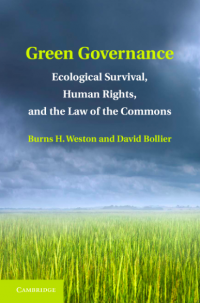
After three years of hard work, I am pleased to announce that my new book – co-authored with Professor Burns Weston of the Center for Human Rights at the University of Iowa College of Law – has just been published.  Green Governance:  Ecological Survival, Human Rights and the Law of the Commons was recently released by Cambridge University Press.  Here is a short summary of the book:

The vast majority of the world’s scientists agree: we have reached a point in history where we are in grave danger of destroying Earth's life-sustaining capacity.  But our attempts to protect natural ecosystems are increasingly ineffective because our very conception of the problem is limited; we treat “the environment” as its own separate realm, taking for granted prevailing but outmoded conceptions of economics, national sovereignty, and international law.  Green Governance is a direct response to the mounting calls for a paradigm shift in the way humans relate to the natural environment.  It opens the door to a new set of solutions by proposing a compelling new synthesis of environmental protection based on broader notions of economics and human rights and on commons-based governance.  Going beyond speculative abstractions, the book proposes a new architecture of environmental law and public policy that is as practical as it is theoretically sound.

The book has a number of significant endorsements.  At the risk of immodesty, here are a few of the blurbs for Green Governance:

James Gustave Speth, Former Dean, Yale School of Forestry and Environmental Studies, and Professor of Law, Vermont Law School:

“When a vital body of existing policy and law has run its course, the need for reinvention becomes urgent. So it is with environmental law and policy. It is therefore exiting that two enormously well-informed and creative thinkers, Burns Weston and David Bollier, have joined forces to produce this breakthrough in environmental governance. Their book is a landmark in our thinking about rights-based environmentalism and the law of the commons and how these fields can combine in a powerful synthesis. We must take these ideas very seriously indeed. Highly recommended.”

Syndicate content