environment

The Community Environmental Legal Defense Fund has been doing pioneering work for many years in trying to protect the rights of communities against corporate enclosures, especially in its home state of Pennsylvania.  This work is impressive for trying to blend civil disobedience and law at the municipal level:  a bold, creative strategy to forge new legal standards to protect the environment and the rights of communities.

The executive director of CELDF, Thomas Alan Linzey, recently published a powerful piece about a landmark ruling by a Pennsylvania judge holding that corporations are not “persons” under the state constitution. The litigation revolved around a claim by Range Resources, a gas extraction corporation, that it has a constitutional right to privacy under the Pennsylvania Constitution.  The corporation had tried to prevent the public release of a sealed settlement agreement between it and a family in western Pennsylvania that said its water had been contaminated by fracking. 

But Judge Debbie O’Dell-Seneca of the Washington Court of Common Pleas denied the request, saying that “in the absence of state law, business entities are nothing.”  If corporations can claim independent rights, she held, then “the chattel would become the co-equal to its owners, the servant on par with its masters, the agent the peer of its principals, and the legal fabrication superior to the law that created and sustains it.”  It turns out that Range Resources and other corporations had paid out $750,000 to settle claims of water contamination caused by fracking.

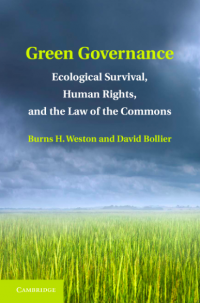
After three years of hard work, I am pleased to announce that my new book – co-authored with Professor Burns Weston of the Center for Human Rights at the University of Iowa College of Law – has just been published.  Green Governance:  Ecological Survival, Human Rights and the Law of the Commons was recently released by Cambridge University Press.  Here is a short summary of the book:

The vast majority of the world’s scientists agree: we have reached a point in history where we are in grave danger of destroying Earth's life-sustaining capacity.  But our attempts to protect natural ecosystems are increasingly ineffective because our very conception of the problem is limited; we treat “the environment” as its own separate realm, taking for granted prevailing but outmoded conceptions of economics, national sovereignty, and international law.  Green Governance is a direct response to the mounting calls for a paradigm shift in the way humans relate to the natural environment.  It opens the door to a new set of solutions by proposing a compelling new synthesis of environmental protection based on broader notions of economics and human rights and on commons-based governance.  Going beyond speculative abstractions, the book proposes a new architecture of environmental law and public policy that is as practical as it is theoretically sound.

The book has a number of significant endorsements.  At the risk of immodesty, here are a few of the blurbs for Green Governance:

James Gustave Speth, Former Dean, Yale School of Forestry and Environmental Studies, and Professor of Law, Vermont Law School:

“When a vital body of existing policy and law has run its course, the need for reinvention becomes urgent. So it is with environmental law and policy. It is therefore exiting that two enormously well-informed and creative thinkers, Burns Weston and David Bollier, have joined forces to produce this breakthrough in environmental governance. Their book is a landmark in our thinking about rights-based environmentalism and the law of the commons and how these fields can combine in a powerful synthesis. We must take these ideas very seriously indeed. Highly recommended.”

For all the enthusiasm that “going local” has garnered in recent years, securing local control as a legal entitlement is generally a very different matter.  Federal and state law tend to place strict limits on what local communities can do to protect themselves from outside commercial forces.

A hearty salute, then, to the path-breaking work by the Community Environmental Legal Defense Fund, a Pennsylvania nonprofit that provides legal advice and advocacy for municipal governments and, more recently, international allies.  Journalist Barry Yeoman has a terrific profile of CELDF, Rebel Towns,” in the latest issue of The Nation (February 4). 

The truth of the matter is that local communities don’t really have much legal authority to prohibit polluters and extractive industries (mining, water-bottling, timber companies) from coming into their towns and ruining the place.  In the U.S., at least, and in most other places around the world, national governments have the sovereign power to override local authorities, and they are only too willing to do so.  After all, politicians’ partnerships with major industries help grow the economy, boost tax revenues and reap political contributions to repeat the whole cycle. 

Of course, the “market externalities” that result -- poisoned soil, polluted rivers, etc. – aren’t taken into account.  The traditional response of public-interest attorneys is to “work within the system” to deal with these problems, using available laws and judicial processes.

Open Up the Coast to Everyone

At one time in American life, a day at the beach was open to anyone.  Over the past fifty years, however, that expectation has been slowly eroded and parceled into expensive, privately owned beachfront lots.  As Marquette professor Andrew W. Kahrl writes in The New York Times  “…up and down the Eastern Seaboard, beachfront property owners, wealthy municipalities and private homeowners’ associations threw up a variety of physical and legal barriers designed to ensure the exclusivity — and marketability — of the beach. These measures were not only antisocial but also environmentally destructive.”

The historic bulwark against the enclosure of coastal lands has been the public trust doctrine, a legal principle with deep roots in Roman law that was eventually incorporated into British and then American law.  However, U.S. state courts have generally given the public trust doctrine very different interpretations, and state legislatures have enacted different standards of public access to and ecological protection of coastal lands. 

As a result, states like California and Texas have remarkably open access to all beaches while eastern seaboard states like Connecticut and New Jersey have fairly restrictive rules.  Such states apply the public trust doctrine only to fishing and navigation, for example.  It is not widely appreciated that this is not just unfair to people who can't afford to buy or rent their own beach house, it’s an environmental danger.

Every year the Elevate Festival in Graz, Austria, awards its International Elevate Award to an exemplary project of commoners, a recognition that comes with a 2,500 euro prize.  Elevate is a rare event that brings together cutting-edge music with leading thinkers about the commons and politics.  What a combo!  I had the privilege to attend four years ago, which led to some collaborations on the commons that continue to this day.

The Elevate Awards don't just recognize past achievements, but also future promise.  As the name "elevate" implies, the awards seek to recognize under-recognized but strong, innovative projects that take account of "the environmental and cultural commons of our planet." 

The 2012 winner of the Elevate Award has just been announced:  the Women’s Network for Sustainable Development in Africa, or REFDAF. The Senegal-based organization is a network of hundreds of grassroots women’s associations in the southern regions of West Africa.  It’s dedicated to the empowerment of women to establish their own livelihoods through sustainable regional production. A live-stream of the awards show on October 28 will be shown here.

The brave new world of “owning life” began 32 years ago when the U.S. Supreme Court first approved the patenting of a genetically engineered bacteria that can help decompose oil.  By a 5-4 decision, it was the first instance of U.S. law recognizing ownership in a "manufactured" lifeform.  On Wednesday, I had the opportunity to participate on a panel with the microbiologist who brought that 1980 case, Ananda Chakrabarty, who was then an employee of General Electric. 

The panel was part of a series of live radio programs hosted by Action Speaks! in Providence, Rhode Island, an usually intelligent, spirited show hosted by the genial polymath Marc Levitt.  The theme for this fall’s series is “Private Rights and Public Fights,” which is devoted to looking at “moments when the rights of the individual have clashed with the needs or beliefs of the public—and where the line between private and public has been defined or blurred.”

Anyone who noses around the legal literature soon realizes that the case of Diamond v. Chakrabarty is a real landmark case because it opened the door for the  patenting of lifeforms.  Over the past thirty years, more than 3,000 gene patents have been granted.  Nearly 20 percent of the human genome is now privately owned.  The U.S. Patent and Trademark Office has issued nearly 50,000 patents involving human genetic material.  Patents have been granted for microorganisms, genetically modified plants and animals, stem cells, tissue and many other living things.

Chakrabarty, now is a 74-year-old professor at the University of Illinois College of Medicine at Chicago, had few reflections to offer on the seismic impact of the case.  He was proud of his role in legal and scientific history, but he focused mostly on the scientific aspect of his work and of patent law in general.  Too bad, because I think the extra-legal, extra-scientific ramifications of the Chakrabarty case have been significant. 

Can we begin to reconceptualize how we interact with Nature and afford it the legal protections that are now available only to people?  Along with Bolivia and Ecuador, New Zealand appears to be in the vanguard of this fascinating, welcome trend. 

In his blog about the Northern Territory of New Zealand, Bob Gosford reports that a court there “has recognised – perhaps for the first time in legal history – that a river has personality sufficient to allow it to be heard in a court of law.”  (A tip of the hat to Tim Gregory for passing this news along.)  Gosford cites reporter Kate Shuttleworth in the New Zealand Herald:

The Whanganui River will become an legal entity and have a legal voice under a preliminary agreement signed between Whanganui River iwi [“peoples” in Maori] and the Crown tonight. This is the first time a river has been given a legal identity. A spokesman for the Minister of Treaty Negotiations said Whanganui River will be recognised as a person when it comes to the law – “in the same way a company is, which will give it rights and interests” … Under the agreement the river is given legal status under the nameTe Awa Tupua – two guardians, one from the Crown and one from a Whanganui River iwi, will be given the role of protecting the river.

One of my working hypotheses has been that commons discourse has great power because it is able to function as an open platform.  It is both general and specific.  I frequently compare the commons to DNA because both are under-specified design structures that evolve and adapt in relationship to local circumstances.  A certain ambiguity and incompleteness in the language of the commons is precisely what enables people to infuse it with their own specific values, needs and aspirations.  And this is what makes the commons both universally appealing and particular in its manifestations.

Now I have found a wonderful confirmation of my hypothesis in the history of the Buffalo Commons.  In 1987, Frank J. Popper and Deborah Popper, husband-and-wife geographers, wrote an essay that argued that some 139,000 square miles of the Great Plains -- the drier parts extending across ten Western and Midwest states – should become a vast nature preserve.  They dubbed their idea the Buffalo Commons, believing that reintroducing the American bison, popularly known as buffalo, could symbolize their vision for the region’s restoration and conservation in ways compatible with human needs.

The Poppers noted that the Great Plains had gone through several major boom and bust periods in American history, in which economic growth resulted in overgrazing, overplowing and excessive water use, which then resulted in busts as people migrated elsewhere, as they did during the Dust Bowl crises of the 1930s. The Poppers proposed that some 10 to 20 million acres of land should be allowed to return to its native vegetation, especially native prairie grasses, and that farming and ranching should be gradually phased out.  Writing in 1987, during yet the third major “bust” phase in the Great Plains, the Poppers realized that neither large-scale government intervention (dams, irrigation projects, etc.) nor conventional economic development (farming, ranching, mining) were sustainable.  Hence the idea of the commons -- a collaborative plan that might emerge from people themselves.

While the official Rio+20 environmental summit will surely be a bust, reaffirming the supposed power of markets to solve our planetary eco-crises, the alternative People’s Summit has made some progress toward positive outcomes.  A wide variety of civil society groups from around the world has been meeting since November 2011 to try to hammer out a shared vision that addresses the theme, “Capitalist Crisis, Social and Environmental Justice.” 

The dialogues seek not only to provide a critique of what’s wrong and needs fixing, but to suggest some coherent themes and proposals for moving forward.  I am pleased to report that one of four short working documents produced by the so-called Dialogue Platform of the Thematic Social Forum (TSF) sees great promise in reclaiming the commons.

My colleague Silke Helfrich has been involved in these proceedings, participating in group discussions that occurred in Porto Alegre in January and in Rio de Janeiro in May.  She shared her insights with me from her blog, and will be attending the People’s Summit in Rio in about two weeks.  (See also her excellent presentation about how the commons can help us navigate the coming "Great Transition.")

The People’s Summit bills its gathering as “part of a historical process of accumulation and convergence of local, regional and global struggles, that have anti-capitalist, classist, anti-racist, anti-patriarchal and anti-homophobic political frames.” For a fairly short document that emerged from a very diverse group, the Dialogue Platform’s statement on the commons is remarkably deep and subtle.  It is clear to these activists that the problem is not just misguided policies and economic analysis; it involves fallacious mental maps, epistemological categories and modernity itself. 

I am impressed that a large group of this sort could agree on such a statement, and show such depth of understanding about the commons and its role in building a better future.   Here is the Dialogue Platform’s statement:

The Real Agenda of Rio+20

In mid-June, governments from around the world will converge on Rio de Janeiro for a major environmental conference that aspires to come to major new agreements for saving the planet's fast-declining ecosystems.  Since the event comes 20 years after a landmark 1992 environmental conference, this one is called Rio+20. Unfortunately, the conference is almost certain to be a bust because there are no signs that the world's governments are willing to entertain any significant new approaches to environmental protection, least of all ones that would genuinely protect the commons; it would be too economically disruptive and require shifts of power to the 99%.  So the chief task of Rio+20 will be to create the appearance of change.  Early indications suggest that the only green solutions to get any traction will be those that would help develop or expand markets for addressing environmental problems. In other words, a green rebranding for more of the same.In anticipation of this likely outcome, a British anti-poverty campaigning organization, the World Development Movement, has taken the official logo for the event and created a few creative alternatives.  WDM has also launched a "micro-blog" about the need for a "real green economy."  Also check out the People's Summit Rio+20 web portal.  Don't say that you weren't warned.

Syndicate content