Fifteen years ago, the American group Shareable filled a huge void in public consciousness when it began reporting about creative forms of sharing. Its web magazine introduced people to tool libraries, mutual aid networks, food-sharing systems, “sharing cities,” social co-operatives, tiny houses, and other neglected forms of collaboration.
Based in the Bay Area, Shareable is a worker-directed “news and action hub” that, in its words, “promotes people-powered solutions for the common good.” Despite a fairly small staff, the nonprofit has been a catalytic force nationally in promoting commoning and progressive change.
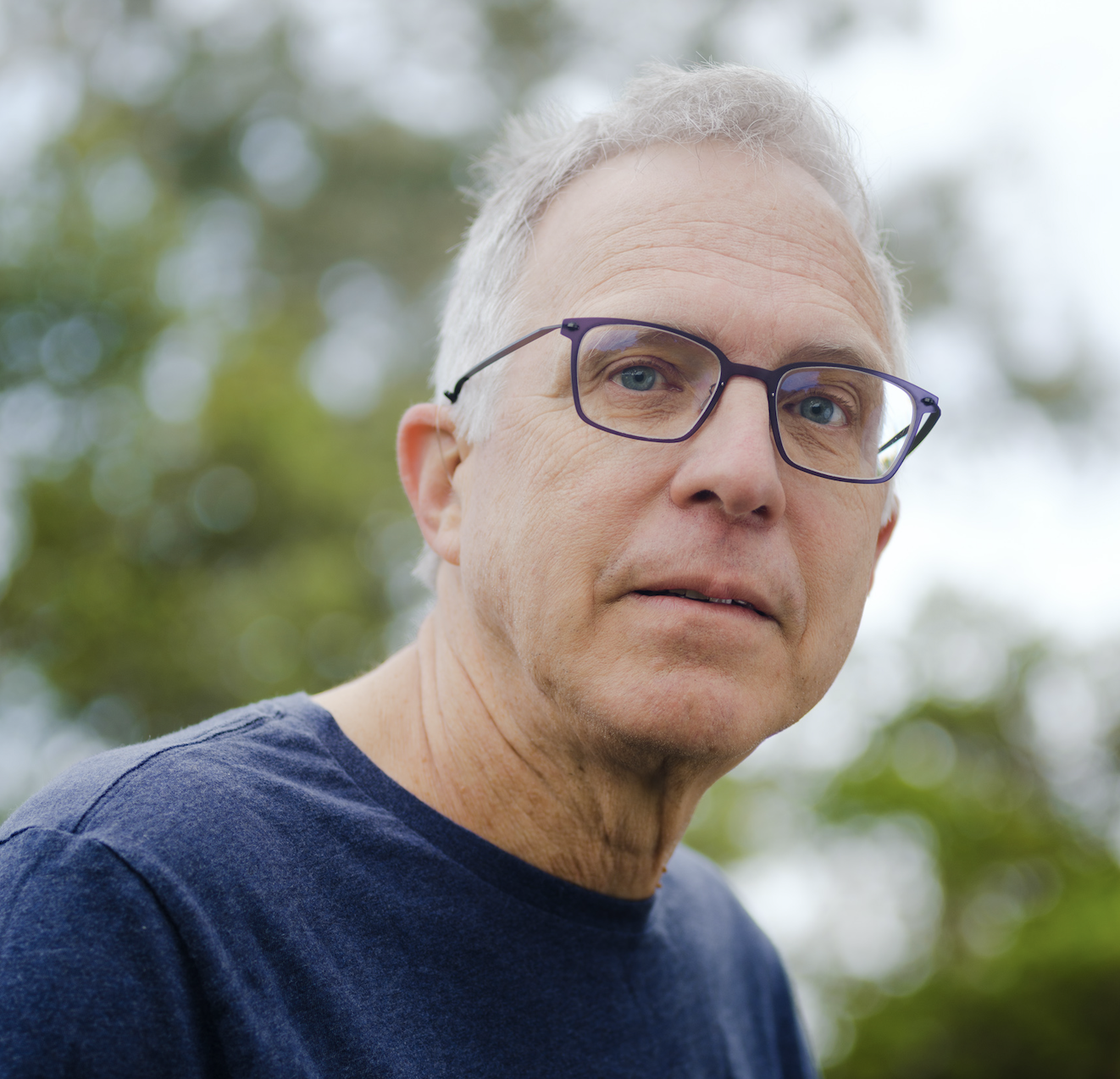
Tom Llewellyn, Executive Director of Shareable
Around 2018, however, Shareable became a victim of its own success in its reporting on commoning. Commercial news outlets stepped up their coverage of Shareable’s themes, expanding social awareness of organized cooperation (hooray) – but that mainstream attention also began to eclipse Shareable’s visibility as a changemaker (boo). Meanwhile, Google and Facebook revamped their digital algorithms to steer Internet users interested in sharing to more popular, mainstream websites, siphoning away a big chunk of Shareable’s followers.
These circumstances pushed Neal Gorenflo, Shareable’s then-executive director, Tom Llewellyn, then-partnerships director, and several staff and board members to realize:Maybe the most urgent priority should be to organize people.
Why is the commons a useful perspective for thinking about urban design and architecture?
Stefan Gruber, a Carnegie Mellon professor of architecture and urbanism, sees cities as a prime site of struggle between capitalism and commons, and at the same time more accessible than most national or international policy venues.
"The history of urbanization is intricately entangled with the history of industrialization and capitalism," said Gruber, citing thinkers like Henri Lefebvre, David Harvey, and Manuel Castells. "Cities provide access to a high concentration of labor and production, infrastructure, trade, finance, and consumption markets."
Yet even though cities have contributed to capitalist growth, Gruber noted, "they have also been the arenas where the contradictions of capitalism, such as inequities, the environment, and class struggle, have played out most visibly." Much of Gruber's work has therefore focused on urban zones where the struggle between capitalism and commons is playing out, with an eye toward learning how commons can prevail, sometimes through commons/public partnerships.
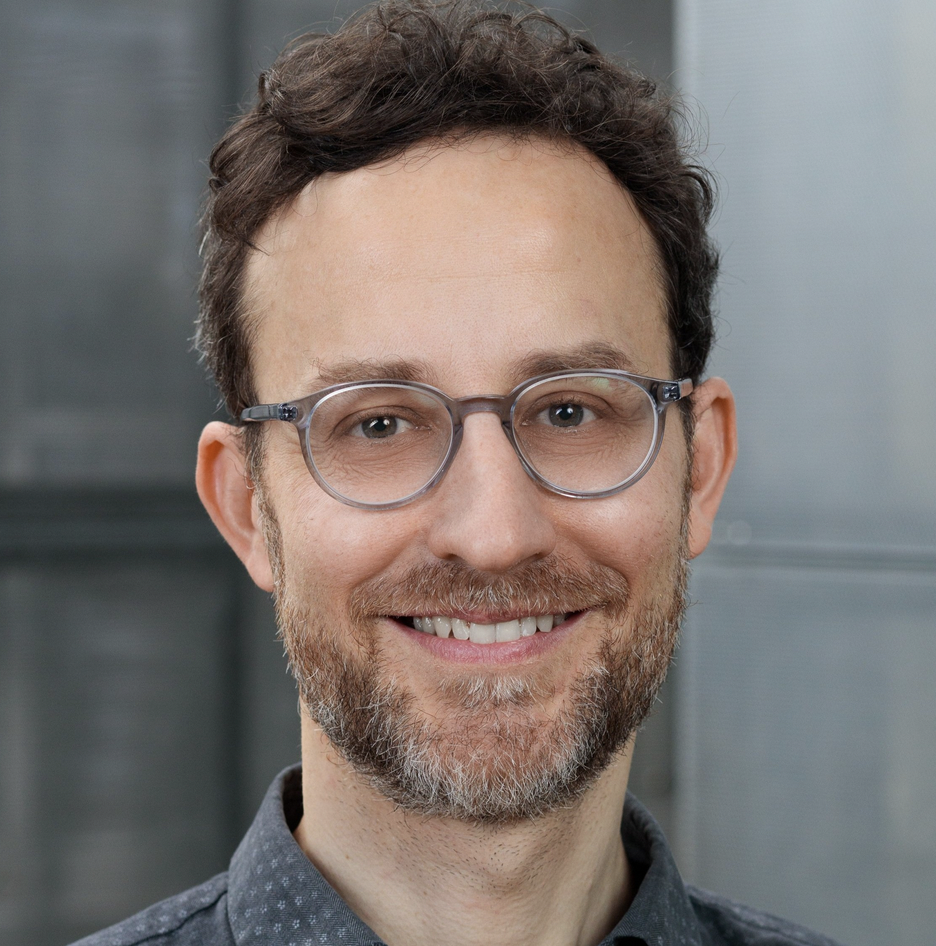
Professor Stefan Gruber
Gruber explores these themes in a course that he teaches, "Commoning in the City," which examines how transitions towards just, regenerative, and self-determined communities in the city might develop, beyond the paradigms of the market and state.
With six co-curators, he has also helped launch a traveling exhibit called An Atlas of Commoning: Spaces of Collective Production,which showcases notable urban commons projects. The Atlas, now on a ten-year international tour, is part of an ongoing visual archive of initiatives that use participatory action, community design, and creative commons/public collaborations to reinvent city life. The Atlas is a collaboration with the German cultural organization ifa (Institut für Auslandsbeziehungen) and ARCH+, a German magazine for architecture and urbanism.
In a few days, the exhibition will have a major opening in Tbilisi, Georgia, a place where "the notion of commons is intertwined with the historical legacies of Soviet collectivism and traditional community practices," and then by rapid urbanization and privatization of public spaces following the collapse of the Soviet Union. Contemporary grassroots initiatives have therefore focused on reclaiming shared (non-state) stewardship of communal spaces, cultural heritage, social practices, and the environment.
The ambitious goal of the Atlas of Commoning is "to recapture and redefine the open and emancipatory space of 'us' as a concept." As the book's preface explains:
As human beings, we are both individuals and members of a community at once; we are interconnected, and that interconnection needs to be given expression—we need places that are dedicated to communal life and that we shape together, conscious of our shared responsibility for them, places where community becomes a lived reality.
The author of the preface, Elke aus dem Moore, cites a Hamburg, Germany, project in the 1990s, "Park Fiction," which invited citizens to articulate their wishes for a future park in pictures or words. The initiative became a participatory art project and then a political vehicle for asserting the needs and desires of residents, eventually defeating the plans of privileged commercial interests.
In my latest episode of Frontiers of Commoning (Episode #55), I talk with Stefan Gruber about the Atlas of Commoning, special challenges of stewarding commons in cities around the world, and his philosophical approach to the topic.
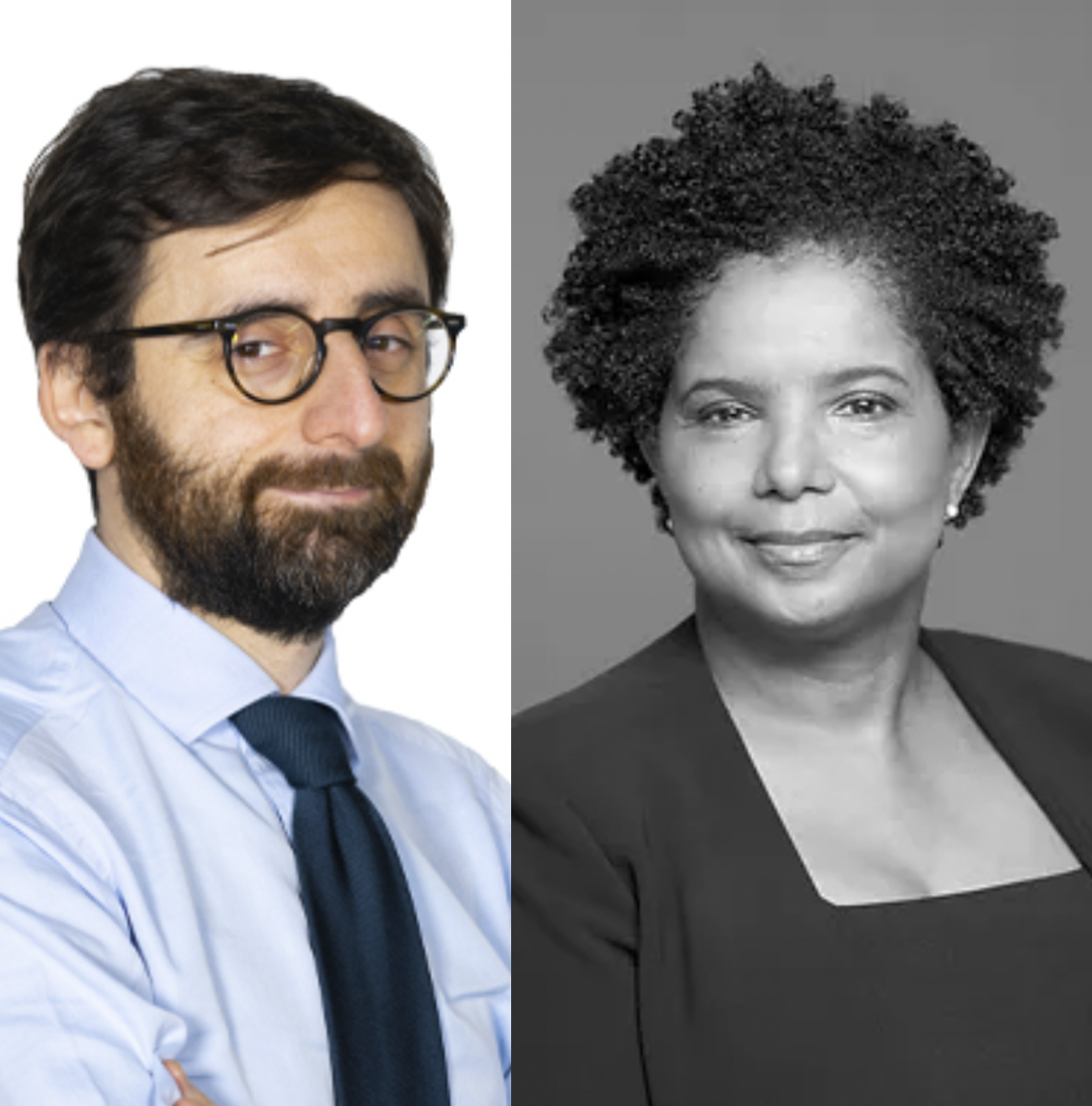
Foster is an urban law and policy professor at Georgetown University who studies the role of cities in promoting social and economic well-being, climate justice, better governance, and in addressing racial inequality. Iaione is professor of urban law and policy at Luiss Guido Carli University in Rome, Italy, where he pioneers creative ways for city governments to work with urban commoners and other stakeholders.
I first met up with Chris ten years ago when he was developing the Bologna Regulation for the Care and Regeneration of Urban Commons -- a formal legal and bureaucratic system for coordinating citizen collaboration with the city government. The Regulation gave rise to hundreds of "pacts of collaboration" through which self-organized citizen groups were given the authority – and city assistance – to rehabilitate abandoned buildings, manage kindergartens and eldercare centers, take care of urban green spaces, and much else.
I gave the following remarks about commons governance on September 27 as part of the U!REKA Lab Lecture Series. U!REKA -- which stands for Urban Research and Education Knowledge Alliance -- is a consortium of eight European universities that studies urban commons. The subtitle of my talk was "Find Answers by Living the Questions."
Thank you, Sandra Bos and the U!REKA Lab, for inviting me to share my ideas about commons governance with you today. It is a great privilege and pleasure.
As I began to gather my thoughts on this topic, I realized that the framing needed to expand. Yes, we must better understand commons governance and the commons more generally. But we must situate this discussion within the larger market/state system that dominates our societies.
This is necessary because commons and the market/state system are so deeply intertwined – even if their co-entanglement is not usually acknowledged. The two systems each represent very different ways of knowing, acting, and being. The struggles between the sovereign and commoners have a long history! They have been intimately conjoined, at least since the 13th Century, when King John signed the Magna Carta and Charter of the Forest.
The sovereign today is not a monarch, but the market/state – a system of governance that is an alliance between market and state institutions. Each has its own realm of authority -- production and governance, respectively – but they both share a deep utopian commitment to endless market growth and “progress.” Today, however, in the face of climate collapse and cascading ecological crises, respectable opinion is slowly come to realize that this vision may itself be a problem. Indeed, this may account for notional mainstream interest in the commons as a source of new ideas.
One stinging lesson that we are learning from the pandemic and climate collapse is that states and markets are not really on top of the situation. They can’t restrain capitalist appetites or provide existential security. I concede that this may be seen as an ideological conclusion, but it is equally a factual observation about the structural limitations of centralized, formalistic, bureaucratic systems. Totalistic regimes of control have trouble managing distributed complexity and change that arises from below.
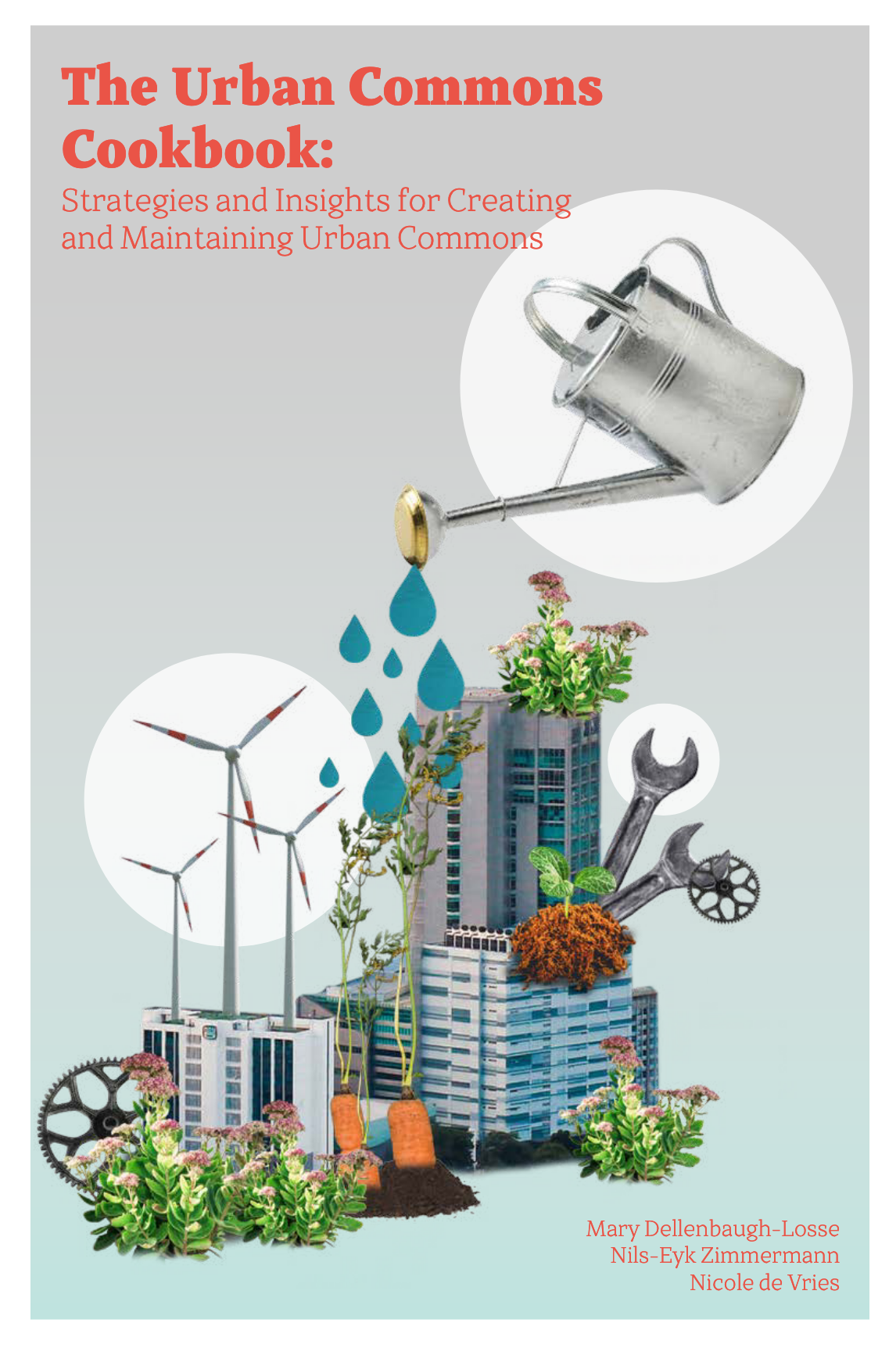
As interest grows in making cities more affordable, convivial places for ordinary people, the arrival of The Urban Commons Cookbook is timely. The new book offers “Strategies and Insights for Creating and Maintaining Urban Commons,” as the subtitle puts it, and helps make the whole idea of urban commons more accessible. It may even convert readers into commoners! Besides providing a quick introduction to commons as a concept, the book offers eight case studies from around the world and practical advice on how to common.
The Urban Commons Cookbookseeks to answer such questions as: “Which ingredients of a cooperative community project most help it succeed? What are urban commons and how do they fit into current activist and civil society debates? And what tools and methods do commoners need to strengthen their work?“
In classic commons fashion, the book was made possible by a crowdfunding campaign on Kickstarter. A big salute to urban researcher Mary Dellenbaugh-Losse and her two collaborators Nls-Eyk Zimmermann and Nicole de Vries of Berlin, Germany, for instigating such a helpful practice-based handbook. Huzzah to Shareable magazine, too, for supporting the publication. (Visit Shareable's website for its considerable literature on urban commons.)
For now, printed versions of the book cannot be quickly obtained in the US and Canada, but Europeans and others can buy them via this link. However, since the book is published under a Creative Commons Attribution-Share Alike 4.0 International License, the authors have made free downloads of PDF versions of the book available from this link.
I appreciated the depth of perspective that The Urban Commons Cookbook provides while focusing on immediate challenges. For example, it explains how the general role of commons in medieval times is not so different from today's role. Under contemporary capitalism as in feudal societies, commons function as self-organized survival mechanisms. Some of the threats to survival come from economic systems (whether emerging or advanced capitalism) while other threats stem from warfare, pandemics or law.
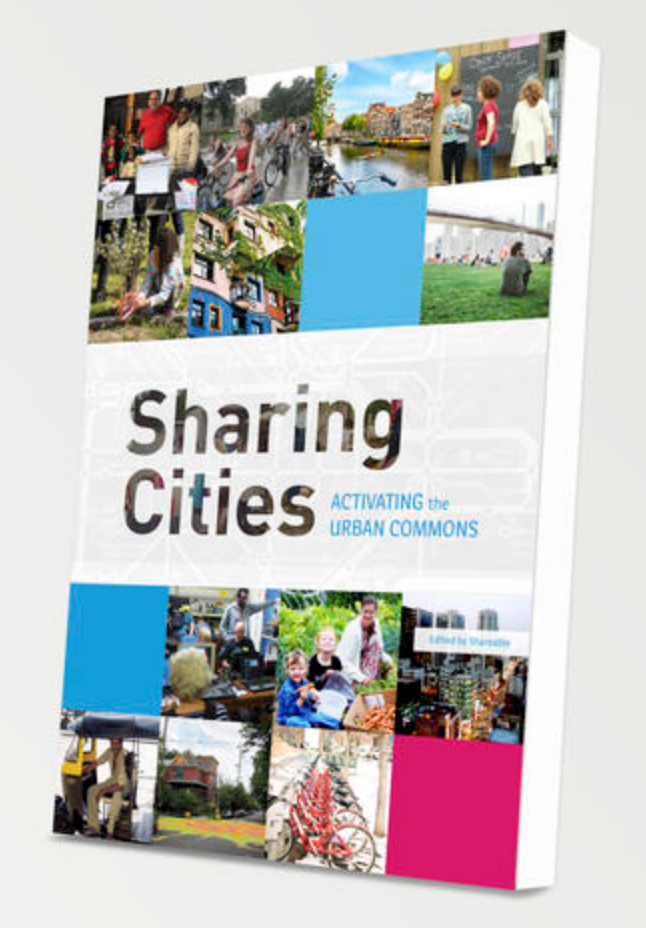
So what might the commons actually achieve for you if you live in a city? How might you experience the joys of commoning? Check out Sharing Cities: Activating the Urban Commons, a fantastic new book that describes more than 100 case studies and model policies for urban commoning. Researched and published by Shareable, the book is an impressive survey of citizen-led innovations now underway in more than 80 cities in 35 countries.
We all know about conventional approaches to “development” championed by investors and real estate developers, usually with the support of a city’s political elites. Much less is known about the commons-based agenda for improving cities. Sharing Cities is an inspirational reference guide for creating such an agenda. It details a great variety of policies and projects that are empowering ordinary citizens to improve their own neighborhoods, reduce household costs, and make their cities fairer, cleaner and more liveable.
I was thrilled to learn about Kitchen Share, a kitchen tool-lending library for home cooks in Portland, Oregon; the consortium Local Energy Scotland that is orchestrating shared local ownership of renewal energy projects; and the “community science” project run by Riverkeeper that carefully collects data about the water quality of the Hudson River.
Big Tech understands the power of data to advance its interests. It’s time for commoners to do the same, especially in urban settings.
A pioneer in this style of high-tech activism is the Brooklyn-based group 596 Acres, whose name comes from apparent number of acres of vacant public land in Brooklyn in 2011 as determined by the NYC Department of City Planning. Since its founding that year, 596 Acres has ingeniously used various databases to identify vacant lots throughout the City that could be re-purposed into public gardens, farms parks, and community meeting spaces.
Paula Z. Segal, an attorney who works with the Urban Justice Center in New York City, explained in a blog post that shortly after its founding in 2011, “the 596 Acres team started hunting down all available data about city-owned land. Once we got the data, we worked to translate it into usable information. For each publicly owned ‘vacant’ lot we found, we asked two questions: 1) ‘Is this lot in use already?’ and 2) ‘Can you reach this lot from the street?’”
The group used a combination of automated script, Google Maps, the interactive community maps at OASISNYC.net, and gardener surveys done by a NYC nonprofit, to identify the unused lots accessible from the street. It discovered that there were approximately 660 acres of vacant public land in New York City, distributed across 1,800 sites. But putting this land to better, public uses required commoners to organize and pressure elected officials and city bureaucrats to transfer ownership and allow the creation of new green spaces.
There is a backstory to 596 Acres’ activism: In the 1990s, many New Yorkers converged on trashed-out parcels of city land, converting them into hundreds of community gardens. This amazing surge of commoning helped to humanize the cityscape while, as a byproduct, raising property values for adjacent buildings in the neighborhood. People could undertake this work only because the vacant lots were open and accessible. (In the era of Mayors Guiliani and Bloomberg, by contrast, any vacant lots are fenced, effectively thwarting the reclaiming of vacant lots and abandoned buildings for commoners.) Guiliani sought to sell off the land that commoners had reclaimed, provoking a fierce backlash that resulted in the creation of scores of community land trusts to manage the gardens.
The beautiful city of Florence, Italy, is nearly overwhelmed by throngs of tourists much of the year, which leads one to wonder: How can residents live and enjoy the city for themselves?
One fascinating answer can be seen in the lovely Nidiaci garden and park. It is a commons dedicated to children that is managed by the residents of the diverse Oltrarno neighborhood and the San Frediano district. The City still legally owns the land, but it has more or less ceded management of the garden to residents who demanded the right to common.
The Nidiaci garden lies behind the apse of the Carmine church, an historic site of the Renaissance. It is an area with lots of tourism, nightlife and gentrification. When I visited the garden recently, mothers were playing with their toddlers and six-year-olds were playing on swings and racing about: the usual playground stuff.
But what makes the Nidiaci garden special is the commoning that occurs there. The neighborhood decides how to use the space to suit its own interests and needs. “Use of the area depends on what people decide to put into it, for free,” as one amateur historian of the Nidiaci garden put it. In a neighborhood in which about 40% of the children come from families born abroad, this is no small blessing.
Not surprisingly, the park has real character. It hosts the only self-managed soccer school for children in the city, where the emphasis is not just on winning but on sportsmanship. There is a Portuguese musician who teaches violin to children and a British writer who teaches English in a studio space on the grounds. An American filmmaker teaches acting.
On a visit to Barcelona last week, I learned a great deal about the City’s pioneering role in developing "the city as a commons." I also learned that crystallizing a new commons paradigm – even in a city committed to cooperatives and open digital networks – comes with many gnarly complexities.
The Barcelona city government is led by former housing activist Ada Colau, who was elected mayor in May 2015. She is a leader of the movement that became the political party Barcelona En Comú (“Barcelona in Common”). Once in office, Colau halted the expansion of new hotels, a brave effort to prevent “economic development” (i.e., tourism) from hollowing out the city’s lively, diverse neighborhoods. As a world city, Barcelona is plagued by a crush of investors and speculators buying up real estate, making the city unaffordable for ordinary people.
Barelona En Comú may have won the mayor’s office, but it controls only 11 of the 44 city council seats. As a result, any progress on the party’s ambitious agenda requires the familiar maneuvering and arm-twisting of conventional city politics. Its mission also became complicated because as a governing (minority) party, Barelona En Comú is not just a movement, it must operationally assist the varied needs of a large urban economy and provide all sorts of public services: a huge, complicated job.
What happens when activist movements come face-to-face with such administrative realities and the messy pressures of representative politics? This is precisely why the unfolding drama of Barelona En Comú is instructive for commoners. Will activists transform conventional politics and government systems into new forms of governance -- or will they themselves be transformed and abandon many of their original goals?
The new administration clearly aspires to shake things up in positive, transformative ways. Besides fostering greater participation in governance, Barelona En Comú hopes to fortify and expand what it calls the “commons collaborative economy” – the cooperatives, commons and neighborhood projects that comprise a remarkable 10% of the city economy through 1,300 ventures.
There has been a surge of new interest in the city as a commons in recent months – new books, public events and on-the-ground projects. Each effort takes a somewhat different inflection, but they all seek to redefine the priorities and logic of urban governance towards the principles of commoning.
I am especially impressed by a new scholarly essay in theYale Law and Policy Review, “The City as a Commons, by Fordham Law School professor Sheila R. Foster and Italian legal scholar Christian Iaione. The piece is a landmark synthesis of this burgeoning field of inquiry and activism. The 68-page article lays out the major philosophical and political challenges in conceptualizing the city as a commons, providing copious documentation in 271 footnotes.
Foster and Iaione are frankly interested in “the potential for the commons [as] a framework and set of tools to open up the possibility of more inclusive and equitable forms of ‘city-making’. The commons has the potential to highlight the question of how cities govern or manage resources to which city inhabitants can lay claim to as common goods, without privatizing them or exercising monopolistic public regulatory control over them.”
They proceed to explore the history and current status of commons resources in the city and the rise of alternative modes of governance such as park conservancies, community land trusts, and limited equity cooperative housing. While Foster and Iaione write about the “tragedy of the urban commons” (more accurately, the over-exploitation of finite resources because a commons is not simply a resource), they break new ground in talking about “the production of the commons” in urban settings. They understand that the core issue is not just ownership of property, but how to foster active cooperation and relationships among people.
 Paula Z. Segal, an attorney who works with the Urban Justice Center in New York City, explained in



Recent comments