
Toward a New Theory of Value (and Meaning): Living Systems as Generative
This is the third section of an essay, "Relationalized Finance for Generative Living Systems and Bioregions," by David Bollier and Natasha Hulst. The remaining two sections will be published tomorrow and Saturday. The full essay can be downloaded as a PDF here.
3. Toward a New Theory of Value (and Meaning)
In rethinking how “nature finance” should be structured, the distinctive modes of value-creation in commons and bounded markets are often misunderstood. Standard economics sees market exchange, money and growth as the only significant engines of wealth-creation, a process that finance purports to facilitate. It is therefore difficult for conventional finance to understand that there are many other distinctive species of “value” that ecosystems and organized commoning generate.
The word “value” brings to mind money and markets, but the value generated by nature is quite different in an ontological sense. The bounty brought by rainfall, fertile soil, and biodiversity cannot truly be expressed through quantitative proxies, prices, algorithms, or markets because this “wealth” doesn’t exist in static, objectified forms or essentialist identities. Humans may equate fish with food and trees with lumber, but of course fish and trees play many other ecological roles in sustaining life.[12] The value of living entities subsists within their symbiotic relations – the dense web of interdependencies that generates abundance in a robust, self-sustaining system. This matrix is far more complicated than standard economics or markets can begin to represent.
While it’s possible to see abundance in objectified units (a bushel of apples, a hectare of land), the reality is that this value arises only as part of dynamic, evolving living systems whose actual value eludes quantification and monetization.[13]It may take “thirty leaves to make the apple,” as Thich Nhat Hanh wrote, but businesses, fixated on the marketable fruit, have only a narrow, economic self-interest in the leaves, roots, tree trunk, orchard, ecosystem, and weather.
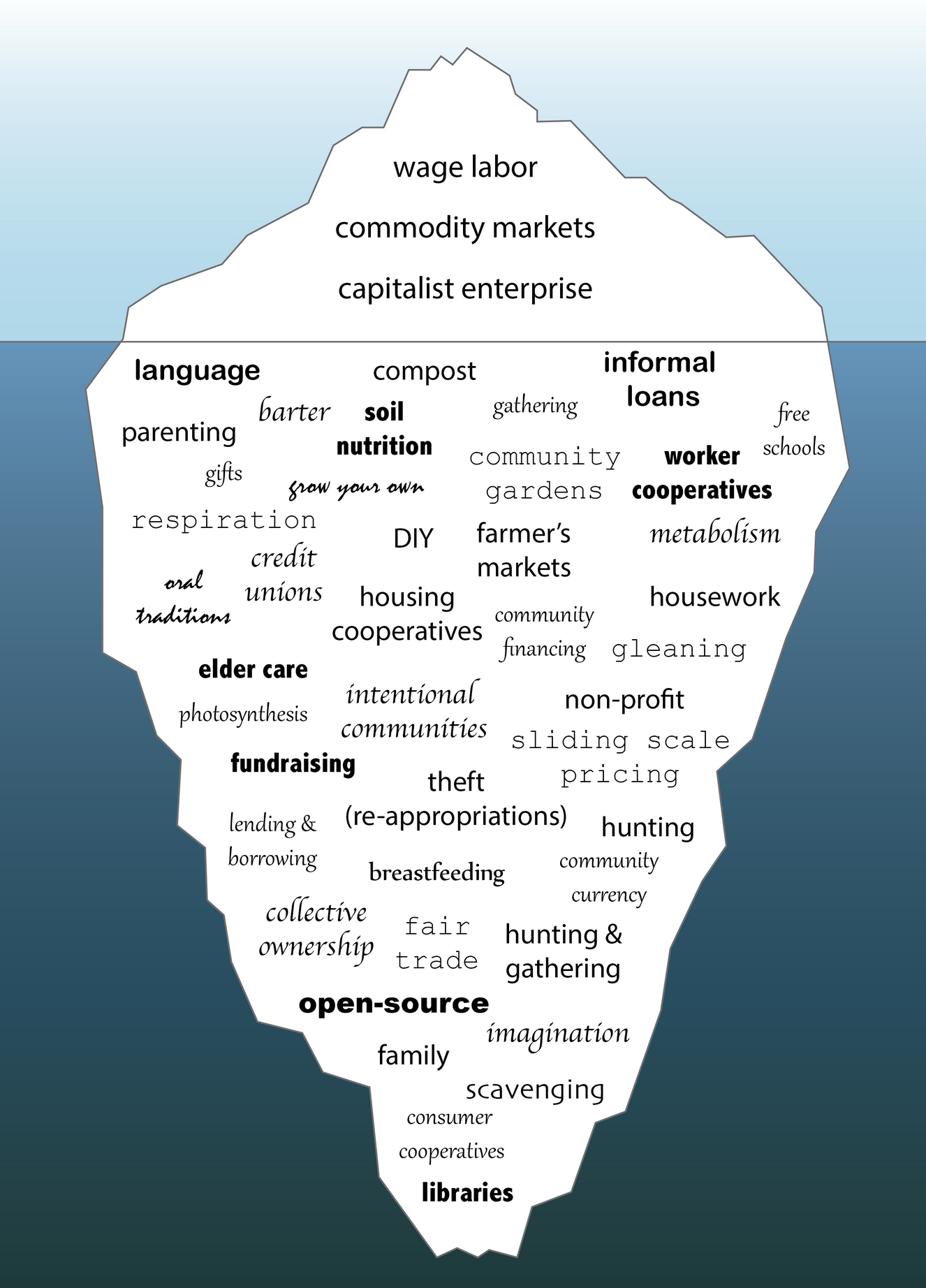
Inspired by feminist economic theory, J.K. Gibson-Graham proposed an iceberg image to suggest how much of “the economy” actually subsists outside of formal markets, remaining largely invisible and treated as inconsequential. The behaviors enumerated by the illustration below suggest how much economic work takes place in non-monetized forms, outside of wage labor and production for capitalist markets. These robust circuits of value-creation, often marginalized by standard economics and finance, can be seen in the generativity of living systems with sufficient organization: ecosystems of diverse organisms, agroecological farming, permaculture practices, online communities of collaboration, mutual aid networks, gift economies such as blood banks, scholarly disciplines, and artistic circles, timebanking collectives, and so on. Their contribution to “the economy” is enormous, but it is typically understated or ignored.





 My visits and events were actually a kind of field research for me. I learned a lot about what people know and think about the commons, what initiatives they are already involved with, and what topics need more attention. I also made some new friends and acquaintances along the way.
Recent comments