It’s becoming clear that modern industrial agriculture is destroying the planet – by using massive qualities of chemical pesticides, herbicides, and fertilizers; fossil fuels to transport food across thousands of miles; and monoculture techniques that require unsustainable productivity. All this is eroding the soil, reducing biodiversity, and destroying the generative power of ecosystems.
It's easy to get discouraged by these realities. But talk with Howard Koster, a Dutch farmer who is developing new models of organic farming and agroforestry, and you'll come away inspired and hopeful. Working with two other farmers, a grassroots financial partner, and the local community, Koster's paradigm of small-scale farming inverts most of the ecological, social, and financial dynamics of conventional agriculture.
The farm, De Biesterhof, www.biesterhof.nl is in the Duffelt, in the eastern Netherlands, near the German border. It's a 25 hectare (62 acre) agroecological farm that grows perennial grains and organic vegetables. To encourage natural biodiversity, the farm has planted over 10,000 trees. To help remake the economics of its forms of regenerative agriculture, it is developing a new sort of “relational value chain” for distributing its food to wholesalers, bakeries, grocery stores, restaurants. It also sells fresh vegetables directly to households and welcomes volunteer help through its own CSA (community-supported agriculture) operation.
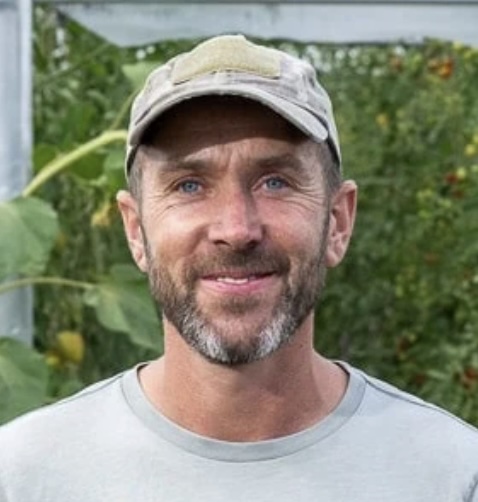
To learn more about how De Biesterhof works, I spoke with farmer Howard Koster for Episode #80 of my Frontiers of Commoning podcast.
After leaving a career in the Dutch military to embark on his new life in farming, Koster quickly realized that he had to unlearn much of what business school had taught him. But he also discovered that there are many partners in his region who also want to build an island of commoning in vast ocean of degenerative capitalist agriculture.
The journey started with the improbable acquisition of a suitable plot of land. Land is exorbitantly expensive in The Netherlands, which makes it especially difficult for new farmers to obtain land and for existing farmers to escape extractive agricultural practices and adopt organic, regenerative practices. Nearly everyone is economically locked into existing commercial systems.
Fortunately, an organization dedicated to improving the ecology of agriculture, Land van Ons (“Our Land”, in Dutch), stepped up in 2022 to buy a conventional dairy farm, with the goal of transforming it into a farm using regenerative techniques. The group's 30,000 members have contributed significant sums to create a pool to buy farmland and decommodify it – in effect, to take it off the market in perpetuity. Land van Ons then hires tenant farmers interested in eco-friendly ways of growing food.
The ownership structure of De Biesterhof is key to its success. Because it's run as a trust dedicated to benefit the community and improve the land, the farm doesn't have to maximize profits for private owners and investors. Surplus revenues can be used to support the farm's infrastructure, equipment, and distribution, and to build long-term strategies for its insurgent type of farming.
Even with its unusual financial support, De Biesterhof has faced formidable challenges in reinventing the farm. It takes years to grow the trees, hedges, shrubs, and other plants for an agroecological farm, which means a transition period of reduced market sales and revenues. To help ease the farm through this transition, Land van Ons agreed to forgo lease payments until 2030. This has given Koster and his colleagues time to grow an eight-hectare “alley cropping” system that integrates plum, hazelnut, and apple trees with 36-meter-wide strips of arable land., along with over 8,000 trees in hedgerows.
The farm is also planting a five-hectare food forest to develop positive interdependencies among crops, plants, trees, birds, and insects. While De Biesterhof has already earned organic certification, it is committed to constantly expanding and improving its regenerative practices, such as no-till growing of crops.
Koster notes that while modern agriculture has become incredibly productive, much of it comes at the expense the environment. Water companies are spending billions of euros a year cleaning drinking water – something that used to be clean through natural processes. And now “forever chemicals and plastics” are adding new pollutants.
“There are all these other ecosystem services that agriculture can and should be doing,,” said Koster, “including just creating an attractive landscape, purifying water, increasing biodiversity, storing carbon, and taking nitrogen out of the air. These are things that can be done, and that we will be doing on our farm,” said Koster. “But they are not valorized in the current system.”
He added that putting price tags on ecosystem services can intensify the marketization of natural systems that has caused so many problems in the first place. However, Dutch government payments for biodiversity do help make it more feasible for farms like De Biesterof. He noted that The Netherlands spends billions of duros on its military; why not for food security as well? The Russian war on Ukraine has highlighted how wheat markets can become precarious – a problem that can be mitigated by relocalizing food production.
Part of the answer lies in building new types of regional supply chains and local food systems, which is mostly about bringing people together in new ways and modifying how food is distributed and prepared. Koster noted that most people don't realize that, in The Netherlands, about 90 to 95 percent of all domestic wheat is grown as animal feed. “We import the rest of our wheat for humans from countries like Ukraine and Italy, which has made it near impossible economically to grow wheat for human consumption locally,” he said.
Koster's response has been to work with small-scale bakers to adapt their baking processes and recipes, so that they can use locally grown wheat with higher amounts of gluten than wheat grown for animal feed. It has taken time, relationship-building, and new distribution arrangements, but there are the beginnings of a new “relational value chain” for growing, distributing, preparing, and retailing wheat into bread.
You can listen to my interview with Howard Koster at this link. I visited De Biesterhof in June 2026 as part of a summer school on Food Commons organized by Dr. Oona Morrow at Wageningen University. While on the farm, I was interviewed by Dr. A.J. Calo about many challenges facing smallholder farms in “going regenerative.” See the transcript, “Property vs. Commons,” at this Substack link.)





Recent comments