
With so many social movements seeking system change – cooperatives, commons, Doughnut Economics, peer production, relocalization and more – things quickly get confusing. There are so many different vocabularies, political premises, and theories of change swirling about. How can we possibly work toward a coherent, common future?
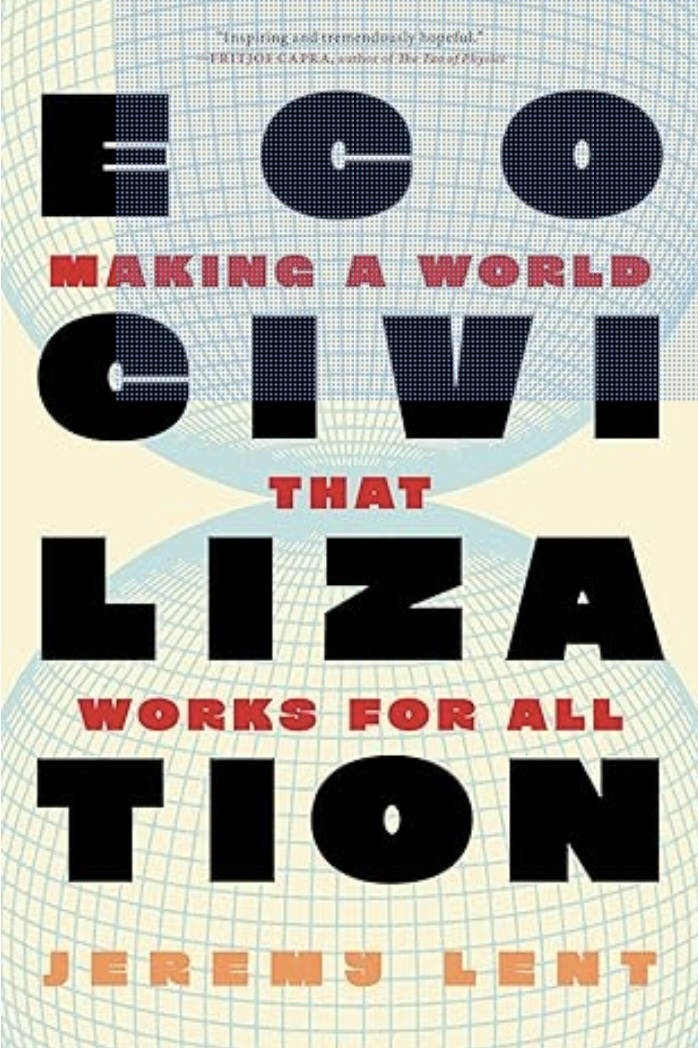
Jeremy Lent’s new book, Ecocivilization, is a significant beachhead in answering this question. It demonstrates that a feasible future is possible precisely by drawing upon the rich pluriverse of possibilities. Lent’s book is therefore a relief to encounter. At last, a bold, empirically grounded vision of how diverse players could construct a post-capitalist world.
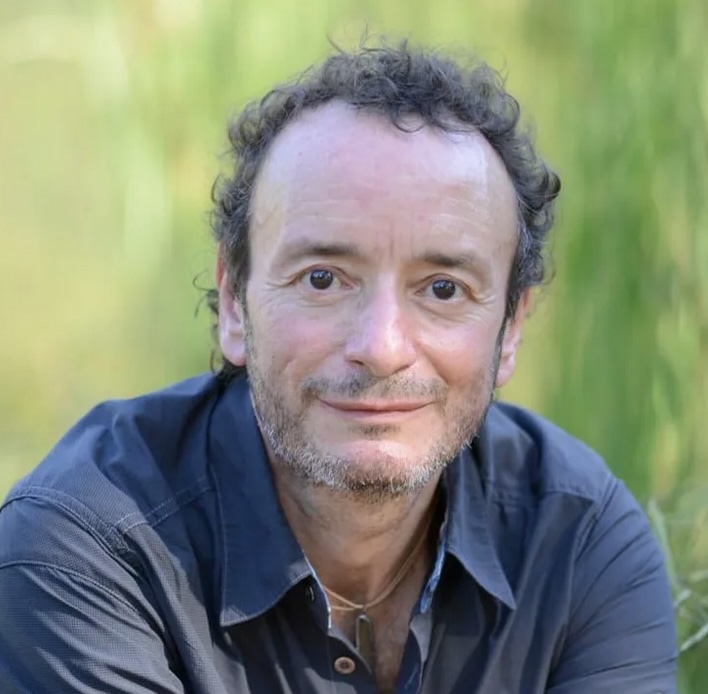
I’ve known Jeremy and his thinking in previous books for eight or ten years, especially through The Patterning Instinct and The Web of Meaning. The Patterning Instinct, published in 2017, distills a vast scholarly literature to describe humanity’s search for meaning – from the time of hunter-gatherers to early agricultural civilizations to modern societies and religion traditions. The Web of Meaning, published in 2021, explores how traditional wisdom and modern science could together provide a new narrative for modern humans. (My 2021 blog post and podcast interview with Jeremy about The Web of Meaning, can be found here.)
Naturally, I was excited to learn more about Ecocivilization, a book that Lent had been working on for five years. So I asked Jeremy to join me on my podcast, Frontiers of Commoning (Episode #74) to talk about his journey in writing the book and to discuss its arresting themes.
Ecocivilization starts by providing an incisive overview of the history of modern capitalism. He introduces the mythical Indigenous figure of Windigo as a shorthand for the voracious, predatory hunger driving capitalism. Windigo is a terrifying monster in Ojibwe mythology that is always hungry and has a heart of ice.
“If it caught you, it would take a bite out of you. And the more of you that a Windigo ate, the hungrier it got,” said Lent. “The worst thing was, if you got bitten by one, you turned into a Windigo monster yourself, doomed always to roam the world to eat more and more, never satisfied.
“When Europeans arrived in North America with a gold fever and a desire to keep taking more and more, the Ojibwe looked at them and said, ‘This is Windigo!’”
After a few succinct chapters on the pathologies of capitalism, Ecocivilization gets down to the work at hand – explaining multiple strategies for revamping the economy. In sixteen chapters, he addresses a wide spectrum of domains – business organization, agriculture, technology, finance, infrastructures, law, global governance, and more.
Here’s a quick sampling of the types of prescriptions that Lent offers:
Industry must begin to embrace the principles of the “circular economy” to minimize wastes and begin to account for the market “externalities” (pollution, social disruptions, over-development) of conventional commerce.
Agriculture must embrace agroecology priniciples and perennial crops. It must move away from factory farming and toward small farms and local food systems.
Wealth inequality can be addressed through caps on wealth, inheritance taxes, and commonwealth trusts serving the common good.
Modern systems of fiat currency need to make room for alternative currencies, community-owned public banks, and debt jubilees to wipe debts clean. Universal basic income schemes should be enacted.
To escape growing forms of techno-feudalism, digital technologies need to become open source and distributed, not centralized and consolidated. We need greater commons-based peer production and cosmolocal production (open source design and local physical production). We need public-platform accelerators to help finance and incubate these tech designs, including convivial technologies that escape closed, proprietary systems and enable users to use tech systems to serve their own needs.
What unites the many vectors of change that Lent chronicles is their capacity to bring about stable, sustainable, fair, and dignified ways of life for all. He wants to outline “a new global system of living, one based on life-affirming principles modeled after nature’s own design.”
This is no idiosyncratic personal vision, however. Lent’s goal is to synthesize dozens of proven and promising genres of existing projects and real-world activism. Some of these are daring and paradigm-breaking. Others operate well within the dominant market/state system but offer credible possibilities for post-capitalist transitions.
The framework that Lent uses for conceptualizing system change is known as the “Three Horizons Model.” It posits three interlinked realms of strategy and action. Initiatives operating within the “first horizon” accept the premises of current institutions and try to eke out incremental improvements within them. Think: laws, regulations, and business models to "reform" the system. In our time, horizon one has been largely neutered by big money, political corruption, and free-market ideology.
The “second horizon” is also bounded by current political and economic realities, but its strategies aim to disrupt conventional practices and move beyond them. Sometimes horizon two gambits are exposed as charades or feints toward the transformative. Companies may find it useful to use use deceptive approaches or PR strategies to make their initiatives appear more progressive and consequential than they really are.
Such examples earn the tag, horizon "two-minus.” They can be seen in the plastics industry’s duplicitous recycling programs purporting to solve the problem of plastic waste; and in Wall Street’s ESG (“environmental, social, governance”) investment filters, which were quickly dismantled when the Trump II administration took office.
In some instances, however, horizon two strategies actually open up new fissures in conventional logics and politics, providing enough visibility and space for activists to open up pathways to horizon three – an Ontological Shift to a new paradigm.
The third horizon, writes Lent, refers to “ideas that are outside the ballpark, shifting the entire paradigm and thus permitting possibilities that could never have been imagined within the first two horizons.”
In Ecocivilization, Lent clearly wants to take readers – or at least, those of us in the Western world – to horizon three. These are his preferred examples, but he also, necessarily, cites attractive examples within horizon two that could be helpful.
The hard truth of the matter is that getting from horizon one to the paradigm shift of horizon three – a space unintelligible to people living within horizon one – requires patience, ingenuity, and a sharp machete for hacking a pathway there.
Years ago, Lent created The Deep Transformation Network, an online community that meets every month to help people envisage and work towards an ecological civilization. More recently, Lent has convened the Ecocivilization Coalition, a new group that seeks to actualize some of the transformative ideas described in Ecocivilization, the book.
The group takes inspiration from a bit of wisdom by Nobel Laureate Ilya Progogine, a chemist: “When a system is far from equilibrium, small islands of coherence in a sea of chaos have the capacity to lift the entire system to a higher order.” There are many islands of coherence out there. Can we expand and interconnect them, and begin to enter horizon three?
You can listen to my recent interview with Jeremy Lent here.


Recent comments